
In student housing, a key is never just a key. Every residence hall room, apartment, office, maintenance closet, and common area is a physical access point. Without the right system, lost keys, undocumented access, and delayed follow-up can create security risks for students, staff, and property.
That is why student housing key control needs to be more than a paper log or a hook on the wall. Universities need a reliable way to know exactly who has a key, when it was checked out, why it was needed, and when it was returned.
With HandyTrac, campus housing teams can bring structure, accountability, and visibility to one of the most important parts of residence hall security: controlling physical access.
Why Student Housing Key Control Matters
Campus housing is a high-turnover environment. Student move-ins, move-outs, room changes, maintenance requests, inspections, vendor access, and emergency calls all create daily key activity.
Recent campus safety data reinforces the need for stronger accountability for access. The National Center for Education Statistics reported about 23,400 on-campus criminal incidents in 2021, including 6,500 burglaries and 2,100 aggravated assaults. Institutions with residence halls also reported higher rates of on-campus crime than those without.
While student housing key control is only one part of a complete campus safety program, it plays an important role in helping housing teams document access, reduce uncertainty, and respond quickly when a key is missing or overdue.

The Problem with Manual Key Tracking
Many universities still rely on paper logs, pegboards, lockboxes, spreadsheets, or shared key cabinets. These systems may be familiar, but they often leave too much room for error.
Manual key tracking can lead to:
- Incomplete or illegible key logs
- Keys checked out without proper authorization
- No clear record of who accessed a room or building area
- Delayed response when keys are missing or overdue
- Too many staff members accessing restricted keys
- Inconsistent procedures across residence halls
- Limited visibility during incident reviews
When an issue arises, “I think someone returned it” is not enough. Student housing teams need documented answers.
Best Practices for Student Housing Key Control
1. Limit Access by Role
Not every staff member needs access to every key. A strong student housing key control process should limit key access based on role, building, department, and responsibility.
For example, a maintenance technician may need access to assigned residence halls, while a resident assistant may only need access to specific community spaces or emergency-use keys.
HandyTrac supports role-based permissions, helping managers control who can access specific keys.
2. Replace Paper Logs with Digital Audit Trails
Paper logs can be skipped, misread, altered, or filled out after the fact. Digital audit trails give housing teams a more reliable record of key activity.
A digital student housing key control system helps answer:
- Who removed the key?
- When was it taken?
- Why was it needed?
- When was it returned?
- Is it still checked out?
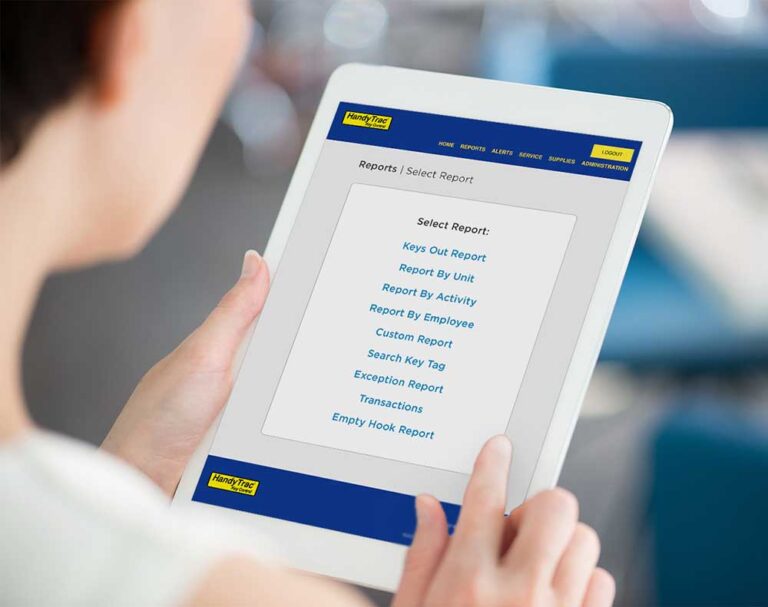
With HandyTrac, managers can access reporting tools that make key activities easier to review, track, and document.
3. Track Missing and Overdue Keys Faster
In student housing, time matters. A key that is not returned on schedule can create unnecessary risk, especially if it provides access to a student room, master key system, mechanical space, office, or amenity area.
Electronic student housing key control helps managers see which keys are still out, who has them, and when follow-up is needed.
4. Reduce Predictable Key Storage
Traditional keyboards often make key locations predictable. Over time, staff may learn where certain keys are stored, which can weaken security.
HandyTrac uses random key rotation, helping prevent predictable access patterns by changing where keys are stored after they are returned.
5. Standardize Procedures Across Residence Halls
Universities often manage multiple residence halls and apartment-style communities. A consistent student housing key control policy should define:
- Who can pull keys
- When keys can be accessed
- How keys must be returned
- What happens when a key is overdue
- How managers review access reports
Clear procedures help improve consistency, accountability, and campus housing security. The Clery Act also requires many colleges and universities to publish an Annual Security Report with three years of campus crime statistics and campus safety information, making accurate documentation especially important.

How HandyTrac Helps with Student Housing Key Control
HandyTrac gives universities a smarter way to manage physical keys across residence halls, student apartments, staff offices, maintenance areas, and shared spaces.
HandyTrac features include:
- Biometric access
- Role-based permissions
- Digital audit trails
- Overdue key reporting
- Random key rotation
- Unit notes and access restrictions
- Mobile app capabilities
- Real-time key activity visibility
With HandyTrac, housing teams can move from “Who had that key?” to clear, documented answers.
A Smarter Way to Manage Student Housing Keys
University housing teams are responsible for protecting students, staff, and property while keeping daily operations moving. A reliable student housing key control system helps reduce risk, improve accountability, and support safer housing operations.
HandyTrac helps campus housing teams track keys, control access, and document activity across residence halls and student housing communities.
Ready to improve student housing key control? Contact HandyTrac today to learn how electronic key control can help your university strengthen accountability and support a safer campus housing environment.